The feature worked exactly as specified—and was still wrong.

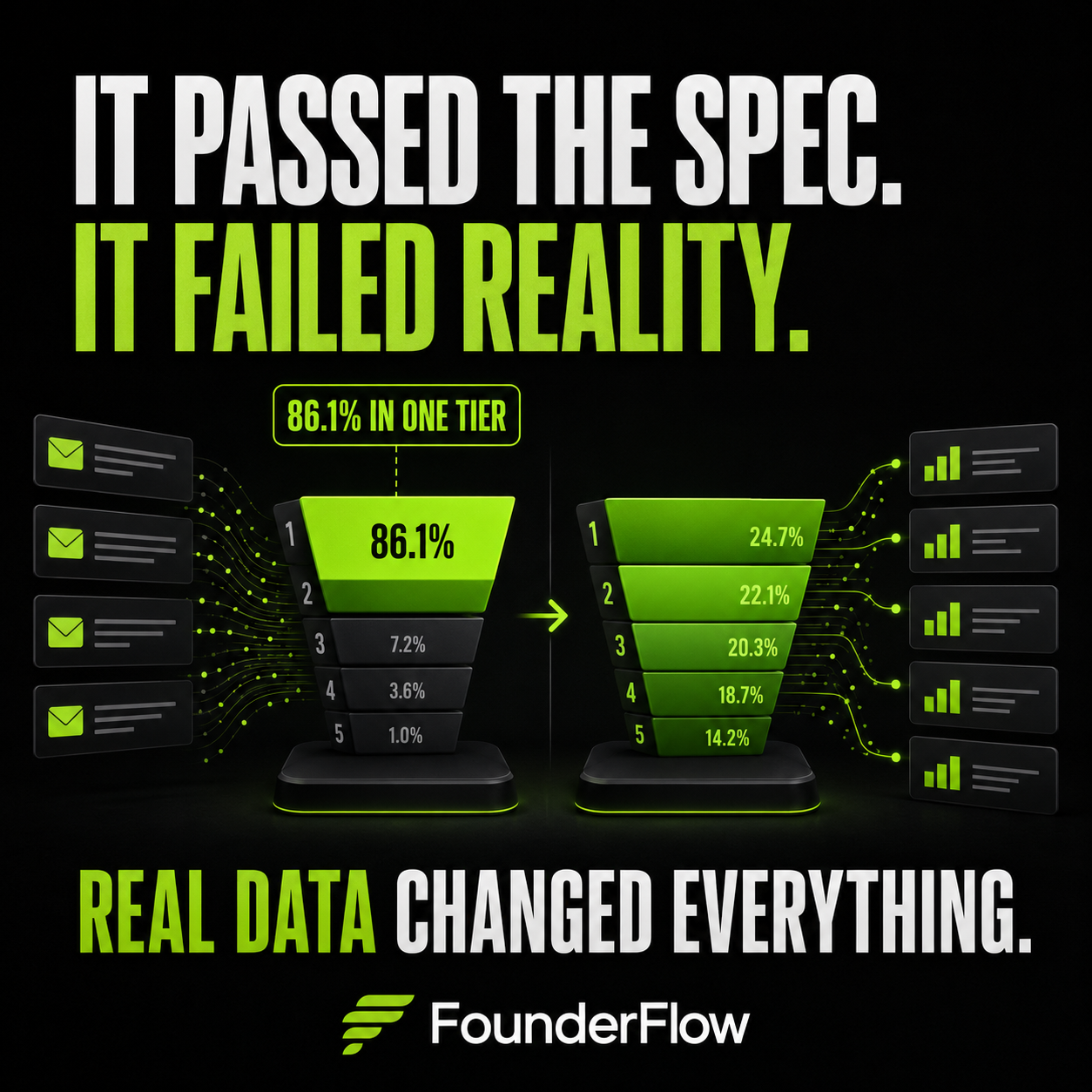
This week, we built a new attention system for FounderFlow that classifies business emails as:
• Act now
• Review today
• Monitor
• Routine
• No action
The first version technically passed the written requirements, but when we tested it against real production data, it placed 86.1% of the inbox into a single attention tier.
That would have made the feature nearly meaningless for founders.
The problem was not the wording of the labels. One of the signals being used was also the default value for unclassified emails. It looked reasonable in the specification but failed when exposed to real inbox behavior.
We recalibrated the system before releasing it. The final production distribution across more than 6,000 emails became:
• Act now: 3.2%
• Review today: 8.9%
• Monitor: 50.7%
• Routine: 33.4%
• No action: 3.8%
Testing also uncovered 222 emails demanding attention even though the work had already been answered or archived. Twenty-seven of those were incorrectly marked “Act now.”
The lesson for other SaaS founders: A feature is not validated because it matches the specification. It is validated when it produces useful results with real customer data.
FounderFlow is being built to function as an AI Executive Chief of Staff—helping founders separate genuine business signals from everyday inbox noise, identify risks and revenue opportunities, and know what requires action.
We are learning that signal quality matters more than simply adding another AI feature.
What is one feature in your product that looked correct during development but behaved differently when tested with real data?
Learn more or try FounderFlow free for seven days:
https://founderflowhq.ai

Flixty — Open-Source Social Media Creator Studio
Open-Source Social Media Creator Studio
Comments (4)

This resonates a lot. We are seeing a similar pattern while testing GEO Tracker AI: a prompt set can meet its count and quality checks, yet still be wrong for the actual business.
For example, an e-commerce product can receive generic or software-style buyer queries that look valid structurally but are not useful for the people who would actually buy the product. So we are moving beyond “did the workflow complete?” and reviewing whether the final prompts match the buyer, vertical and real job to be done.
We are still collecting feedback and test evidence, but it has been a useful reminder: coverage metrics are not the same as signal quality. Real-world relevance has to be the acceptance criterion.
Exactly. “Did the workflow complete?” and “did it produce something useful in the real world?” are two very different tests. Your ecommerce example is a good parallel, technically valid results can still create noise if they don’t reflect what the buyer actually needs.
That distinction between coverage and signal quality is what changed our thinking too. Curious - have you found a good way to measure relevance beyond collecting qualitative feedback from users?

This is a great example of why testing against real usage matters so much. A feature can be technically correct and still fail at the actual job it is supposed to do.
The 86.1% result is especially interesting because it shows how easy it is for one seemingly reasonable default or signal to distort the entire system. I also like that you looked beyond the tier distribution and checked whether emails that had already been answered or archived were still being treated as actionable. That feels like the kind of edge case that would be very difficult to catch with synthetic test data alone.
For Crazy Sajangnim, I’ve seen something similar with product discovery. A feature can technically fetch and display sale products correctly, but once real products and real shoppers are involved, issues like duplicates, irrelevant items, stale discounts, or too much emphasis on one type of product can make the experience feel much worse than the implementation suggests.
I think your point about signal quality is the important one. With AI products especially, “the system produced an answer” is a very low bar. The harder question is whether that answer consistently helps the user make a better decision.
That last point is exactly it, Jinny. Producing an answer is a very low bar if the person still has to figure out whether it matters or what to do with it.
That has become an important distinction for us with FounderFlow: signal quality isn’t just “did we classify this correctly?” but “did we surface something that genuinely deserved the founder’s attention and helped them make a better decision?”
Your Crazy Sanjangnim example is a great parallel. How are you determining when a recommendation is actually useful to the shopper versus simply technically relevant?
Sign in to comment or upvote.