How FounderFlow Works | Your AI Executive Chief of Staff

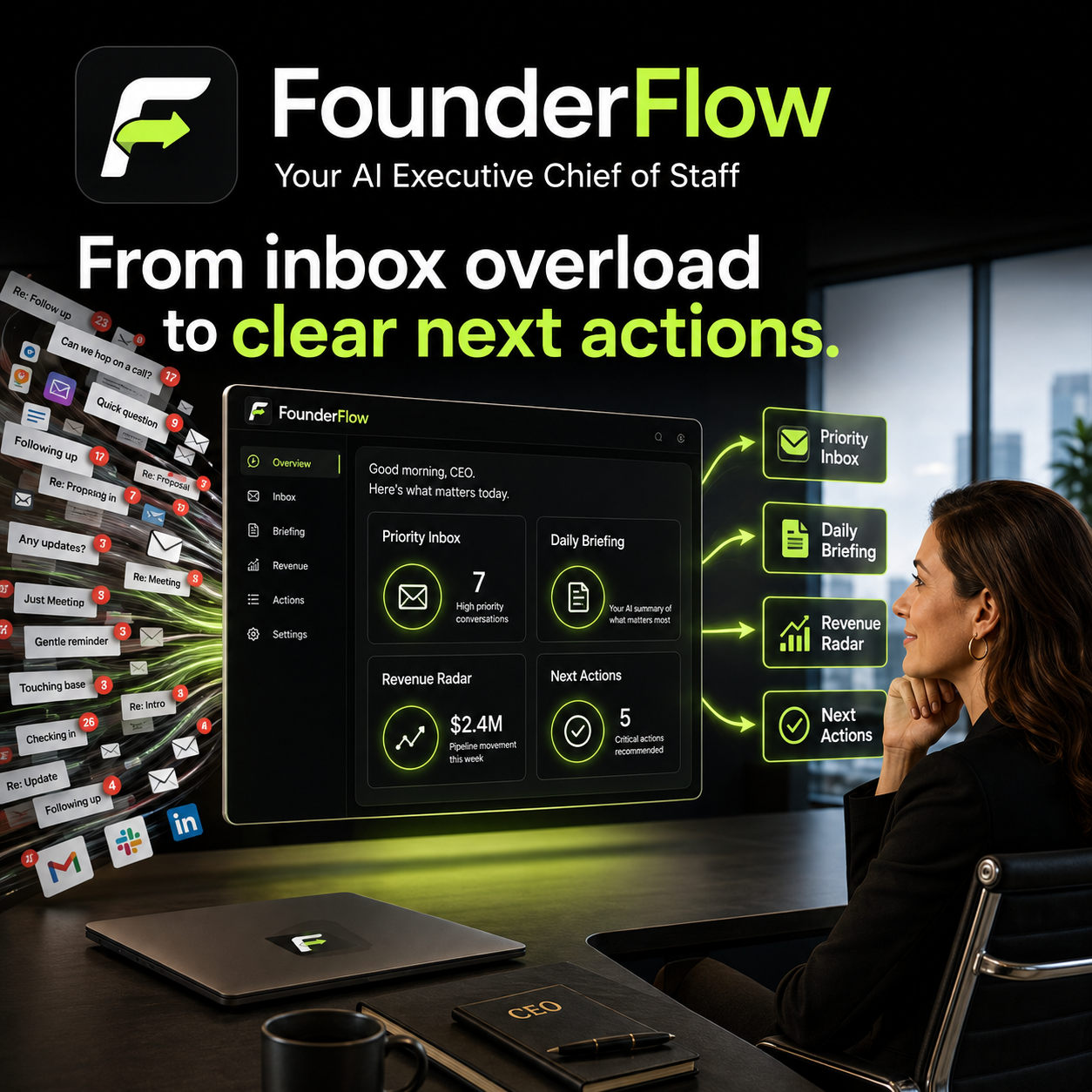
FounderFlow works like an AI Executive Chief of Staff connected to your business email. It reviews the flow of communication across your business, identifies what truly needs your attention, and helps you act before important matters are overlooked.
Once you securely connect your Gmail account, FounderFlow:
Organizes emails by priority, urgency, risk, and business impact.
Creates a daily executive briefing showing what matters most.
Detects revenue opportunities, stalled deals, unanswered prospects, and follow-ups.
Identifies important relationships and remembers relevant business context.
Builds a clearer view of contacts and conversations through its CRM and pipeline.
Recommends next steps and creates draft replies for your review.
Learns your preferences through Business DNA and Train AI so its recommendations become more relevant to your business.
For example, if a valuable opportunity, deadline, customer issue, or compliance request is buried in hundreds of routine emails, FounderFlow is designed to surface it before it is missed.
FounderFlow does not automatically take control of your business or send messages without your approval. It gives you a prioritized executive view, explains what requires attention, and helps you make decisions and respond faster. You can try it free for seven days without entering a credit card.

RedMarker
Get your evenings back from manually checking maths homework.
Comments (4)

Hi Stacy,
This is a really interesting project. I’ve been building something in a similar direction for our own internal use, so I know how much work is involved behind the scenes.
Our system uses a custom worker connected to a database and Vercel, together with a Hermes agent. It connects to email accounts, processes and parses messages, calls LLMs, and stores the relevant data in the database. It covers everything from ICP lead discovery and contact enrichment to personalized email drafts, automated sending, reply and soft/hard bounce monitoring, follow-up sequences, classification, and more.
So I have a pretty good sense of the complexity involved. FounderFlow is clearly more polished and mature than our internal system, although ours is fully custom-built for our specific workflow.
If there’s an opportunity to try FounderFlow, we’d definitely be interested. It would be great to compare notes after using it.
Thank you. It sounds like you have a strong technical understanding of the complexity behind building a system like FounderFlow, so your feedback would be especially valuable.
FounderFlow is designed as an AI Executive Chief of Staff that helps founders identify what needs their attention, protect revenue opportunities, manage important relationships and follow-ups, and determine the next best action without having to search across multiple systems.
We currently offer a seven-day free trial with no credit card required. You can get started at https://founderflowhq.ai. Once you’ve had an opportunity to use it, I would absolutely enjoy comparing notes and hearing how it compares with the custom system you’ve built for your internal workflow.

FounderFlow’s positioning is getting much clearer here. The “AI Executive Chief of Staff” framing makes more sense when you explain that it is not just summarizing email, but trying to identify business risk, opportunities, stalled conversations, and next actions across the inbox.
I also think the approval boundary is important. Saying that FounderFlow does not automatically send messages or take control of the business helps reduce one of the biggest concerns I would have with an AI system connected to a founder’s email.
The part I’d be most interested in seeing is how the daily executive briefing prioritizes conflicting signals. For example, if there are ten “important” items, what makes one genuinely more urgent than another? That ranking logic is probably where the product either becomes extremely valuable or starts to feel like another inbox layer.
The four things I’d be curious about next are: how FounderFlow learns from a founder correcting its priorities, how it distinguishes genuine revenue opportunities from ordinary sales emails, how much historical email context it needs before recommendations become useful, and whether the CRM/pipeline view can eventually replace a separate lightweight CRM for very small teams.
You identified exactly where FounderFlow’s value has to prove itself. The ranking logic is one of the most important parts of the product. FounderFlow considers factors such as urgency, financial impact, relationship importance, deadlines, unanswered commitments, stalled conversations, and the confidence of the underlying evidence. The goal is not to label ten items “important,” but to explain which items deserve attention first, why they matter, and what the founder should do next.
Regarding your four questions:
FounderFlow learns through its Train AI feature and the founder’s corrections. When a founder changes a priority, classification, relationship, or recommendation, that feedback helps FounderFlow better understand what matters within that specific business. We are continuing to strengthen this learning loop so those corrections consistently influence future decisions across the platform.
To distinguish genuine revenue opportunities from ordinary sales emails, FounderFlow examines the sender, conversation history, business context, intent, relationship, pipeline activity, and whether there is evidence of actual buying interest. It also uses confidence levels such as Verified, Very Likely, Needs Review, and Monitor Only rather than presenting every prediction as certain.
FounderFlow begins analyzing information after the inbox is connected, but recommendations become more personalized as it gains sufficient historical and ongoing context. Business DNA also allows the founder to provide important information about the company, priorities, customers, and goals instead of requiring the system to infer everything from email alone.
For very small teams, the CRM and pipeline are intended to cover many of the functions they would normally need from a lightweight CRM, including contacts, relationships, opportunities, stalled deals, next actions, and pipeline risk. FounderFlow also integrates with HubSpot for businesses that already use a separate CRM. Our goal is not necessarily to replace every full-scale CRM, but to prevent a small team from needing another complicated system when FounderFlow can provide the executive visibility they actually need.
And you are right about the approval boundary. FounderFlow can prepare drafts and recommend actions, but the founder remains in control and approves what happens. We want it to become more proactive without becoming reckless. Your questions are exactly the kind of feedback we want from technically experienced early users, and I would be very interested in what you think after testing it.
Sign in to comment or upvote.