FounderFlow Is Starting to Feel Like the Product I Originally Imagined

FounderFlow Is Starting to Feel Like the Product I Originally Imagined
Building FounderFlow has been a constant cycle of testing, breaking things, fixing them, listening to feedback, and realizing that some of the most important improvements are not always the most visible ones.
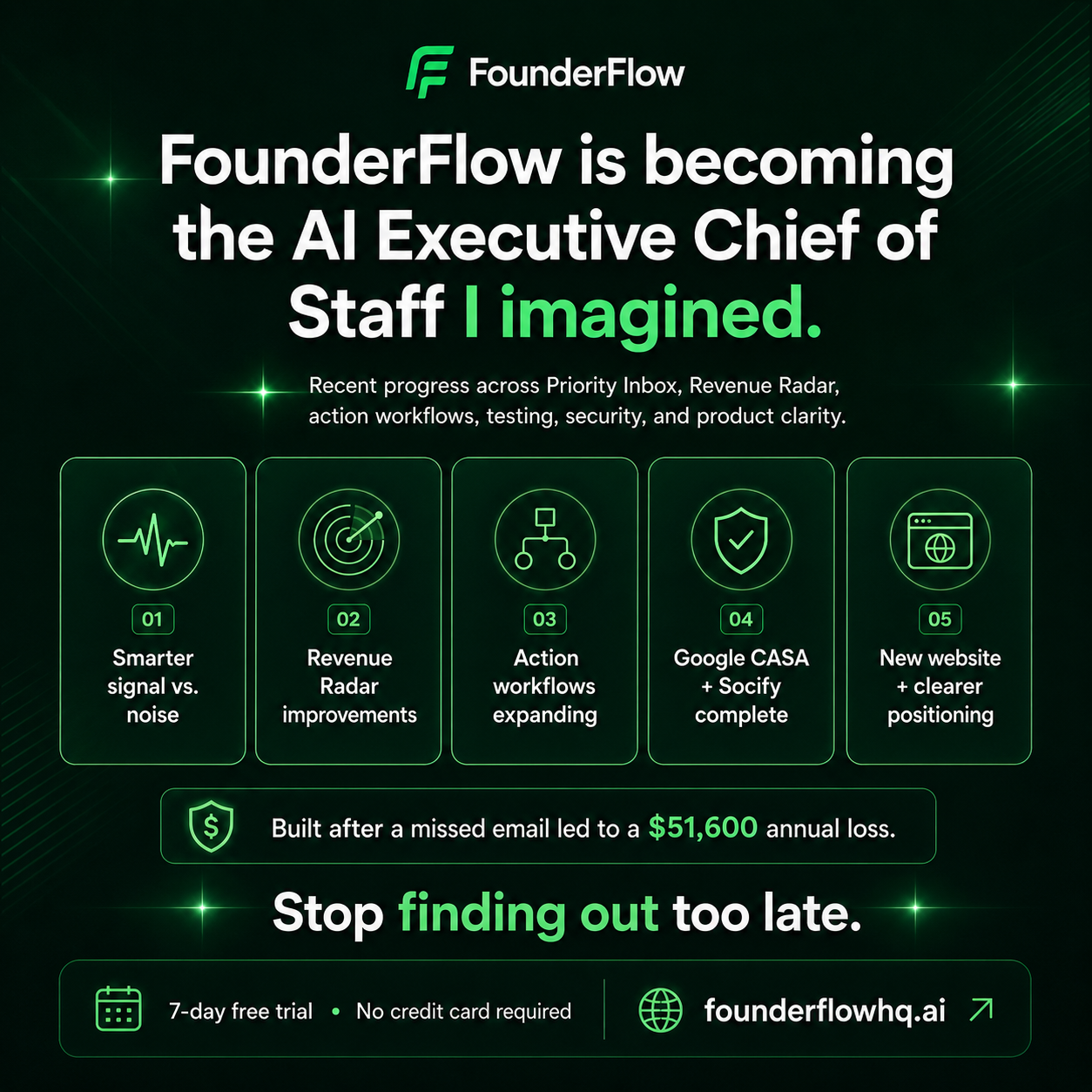
Over the past few weeks, several pieces have started coming together in a way that feels different. FounderFlow is becoming less like an AI tool that helps organize information and more like the AI Executive Chief of Staff I originally set out to build.
The idea behind FounderFlow has always been simple: founders should not have to discover important things too late.
A customer going quiet. A follow-up that never happened. A renewal approaching. A deal beginning to stall. An important email buried under dozens of routine messages. A commitment that was made but never completed.
Those are not just productivity problems. They can become revenue problems.
That is exactly why I started building FounderFlow after a missed email in one of my own businesses resulted in a lost opportunity worth $51,600 per year.
One of the biggest areas of progress has been FounderFlow’s ability to separate signal from noise. The Priority Inbox continues to improve so FounderFlow can distinguish routine communication from messages that may represent a real priority, decision, follow-up, revenue opportunity, or risk.
We have also spent a lot of time correcting classifications. A receipt should not suddenly become an executive priority. An automated payment confirmation should not generate an unnecessary AI reply. An unknown email should not automatically be treated like a VIP. A suspicious message should not appear among the founder’s most important priorities.
Those may sound like small details, but they are critical. An Executive Chief of Staff is only useful if you can trust its judgment.
Revenue Radar is also becoming a much more important part of the product. FounderFlow is being built to identify signals such as revenue at risk, opportunities developing, deals going cold, relationships that need attention, and potential revenue that may otherwise be overlooked.
The goal is not to create another dashboard full of numbers. The goal is to help a founder understand what changed, why it matters, and what they should do about it.
We have also made significant progress on actions. FounderFlow is moving beyond simply identifying problems and toward helping founders resolve them. The product now supports workflows around replying, scheduling, CRM updates, pipeline movement, follow-up tasks, assigning work, and closing opportunities.
One area we recently improved was delegation. During testing, we discovered that some information a founder selected when assigning work, including due dates, permissions, and completion status, was being saved correctly in the backend but was not reaching the teammate’s screen properly. That has now been corrected.
We also found and fixed an issue with our production health checks. The automated check that was supposed to confirm the live site was working after deployment had been silently reporting that no tests were found rather than actually performing the check.
That is exactly the type of issue that reinforces why we have been investing heavily in automated testing. Our Cypress end-to-end testing has expanded significantly, with hundreds of tests now covering more of the product and helping us catch regressions before they reach users.
Security has also moved forward substantially. FounderFlow has completed Google CASA verification, which was especially important because of the level of Gmail access required for the product. We have also completed our recent Socify security work.
For a product that is trusted with business communication and executive-level information, security cannot be something we add later. It has to be part of the foundation.
The website has also gone through a major redesign. This may sound less exciting than AI architecture, but it matters. One of the biggest lessons I have learned while building FounderFlow is that having a powerful product is not enough. People need to understand it quickly.
The new website focuses much more clearly on the actual business problem: FounderFlow watches your business, identifies what matters, protects your revenue, and tells you what to do next.
We are also showing more of the real application rather than asking visitors to imagine what the product does.
The positioning is becoming clearer too. FounderFlow is not trying to replace Gmail. It is not trying to replace HubSpot. And it is not trying to replace ChatGPT.
Those tools each serve a purpose. FounderFlow is designed to sit above the tools a founder already uses and provide an executive intelligence layer across them.
Gmail gives you communication. HubSpot gives you CRM information. ChatGPT helps when you ask it something. FounderFlow is designed to identify the things you may not realize you need to ask about.
That difference is becoming clearer with every iteration.
We are still building. There are still workflows to improve, classifications to refine, integrations to expand, and plenty of things we want FounderFlow to eventually do.
But this stage feels important because the individual pieces are beginning to connect.
Priority Inbox, Daily Briefing, Revenue Radar, Relationship Intelligence, Executive Memory, Pipeline intelligence, actions, delegation, confidence, and evidence are beginning to work together as one system rather than a collection of features.
That is when FounderFlow starts becoming an actual Executive Chief of Staff.
And that is the product I have been trying to build from the beginning.
FounderFlow currently offers a free 7-day trial with no credit card required.
You can explore it at https://founderflowhq.ai
I would especially love feedback from founders who constantly feel like there is something happening somewhere in their business that they are supposed to know about.
Because that is the problem we are trying to solve.
Stop finding out too late.
Comments (0)
No comments yet. Be the first to share your thoughts!
Sign in to comment or upvote.