Building The Product is Only Half The Battle.

Building FounderFlow has been a constant reminder that building the product is only half the battle. Getting the right people to actually stop, pay attention, and book a demo is a completely different challenge.
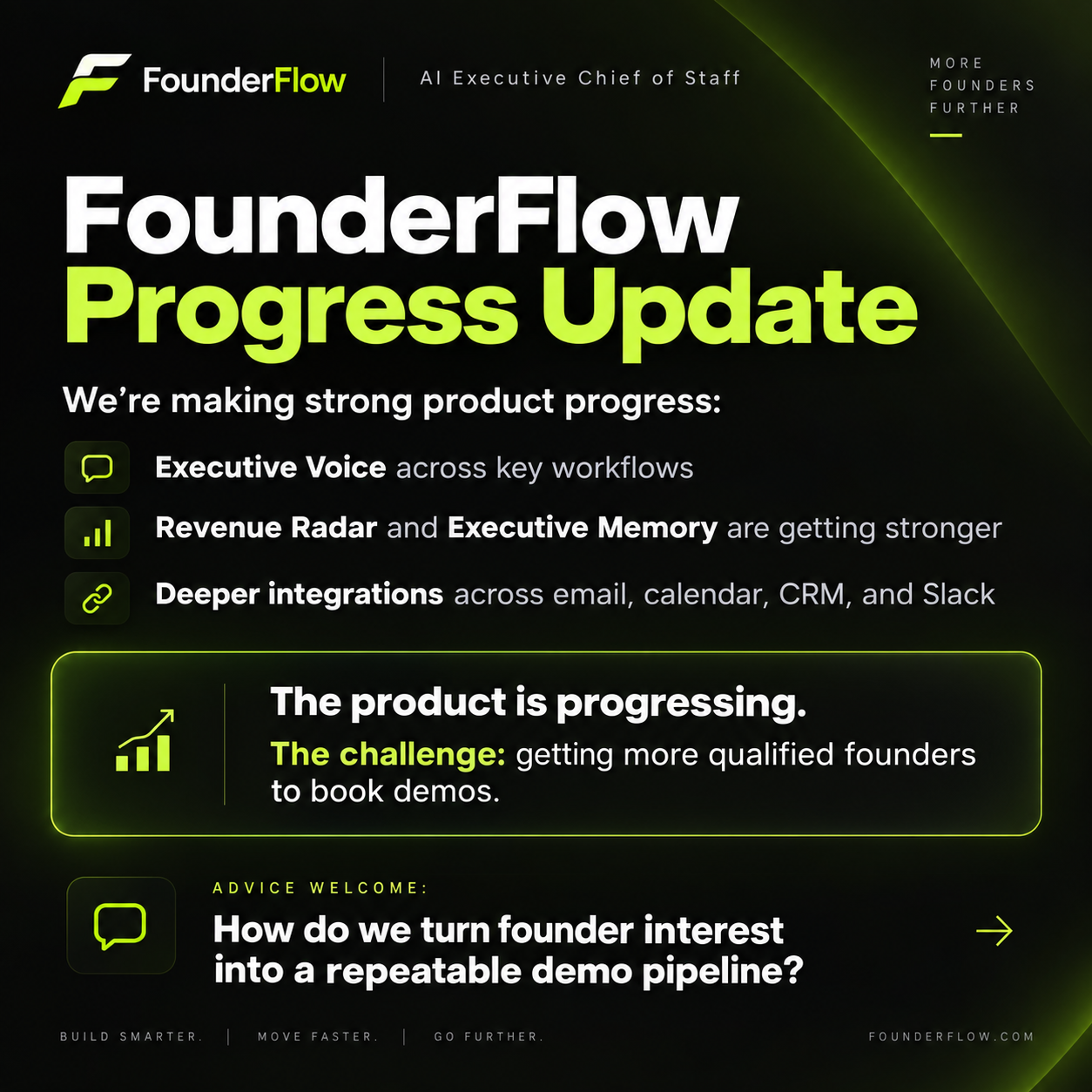
On the product side, FounderFlow has made significant progress.
We are continuing to build toward our vision of an AI Executive Chief of Staff that does more than summarize information. FounderFlow is being designed to identify what requires attention, surface missed opportunities, track commitments, connect information across the business, and help founders decide what needs to happen next.
Some of the progress we have made recently includes:
• Executive Voice across multiple parts of the platform, allowing founders to listen to their Daily Overview, Priority Inbox, Revenue Radar, Pipeline, Relationship Intelligence, Drafts, and Follow Ups.
• Continued development of our Executive Action and Commitment Loop so FounderFlow can detect commitments, assign ownership and due dates, monitor progress, escalate overdue items, and eventually verify that the work was actually completed.
• Improvements to Revenue Radar so founders can identify potential revenue opportunities, incoming revenue, expenses, and business opportunities from the information already flowing through their business.
• Continued work on integrations, including Slack, Gmail, Google Calendar, contacts, CRM data, and other business sources.
• Improvements to Executive Memory and Relationship Intelligence so FounderFlow can understand the people, priorities, commitments, and context surrounding a founder's business.
The technology is progressing.
Our biggest challenge right now is customer acquisition.
We are doing personalized outreach, LinkedIn campaigns, Facebook and Meta engagement, founder communities, email prospecting, and direct follow up. We have generated conversations and interest, but getting qualified founders to actually schedule demos at the volume we need has been much harder than expected.
And I think this is one of those founder problems that deserves an honest conversation.
When you are introducing a product people have never used before, especially a new category like an AI Executive Chief of Staff, how do you get someone to understand the value quickly enough to say:
"Yes. I need to see this."
I would especially like advice from founders who have successfully moved from early product development into repeatable customer acquisition.
What actually worked for you?
Was it founder led outbound?
Highly targeted cold email?
LinkedIn?
Partnerships?
Founder communities?
Paid advertising?
Product led growth?
Free trials?
Showing one very specific pain point instead of explaining the entire platform?
Or did you discover that your messaging or ICP had to change before acquisition started working?
Right now, our priority is not simply generating more impressions or sending more messages.
It is figuring out the shortest path between the right founder seeing FounderFlow and that founder saying:
"This solves a problem I have. Show me."
If you have gone through this stage before, I would genuinely appreciate hearing what moved the needle for you.
Comments (2)
Stacy, the missed QIP requirement on your homepage is a much clearer starting point than the full Chief of Staff pitch. I'd test one short demo for care-home operators: the original email, the unfinished requirement, the deadline, then the alert FounderFlow would show. Let people see that before asking them to book a call. Track replies and bookings separately so you can tell whether the message or the demo step is losing them. Have care operators or founders running several businesses been more likely to book so far?
That's a really useful distinction, especially tracking replies and demo bookings separately. It would help us see whether we're struggling to get people's attention or whether we're losing them once they show interest.
I also like your suggestion of showing one specific problem rather than explaining the whole platform. From what you've seen, do you think that approach works better through a short demo or a real-world example in the first message?
Sign in to comment or upvote.